Why Today’s Bond Market Isn’t a Repeat of 2022
October 22, 2026 | LPL Research
Today’s market article is written by Sam Millette, a portfolio manager on the Investment Management and Research team at Commonwealth. With the firm since 2013, he manages the Commonwealth fixed income research team, responds to advisor requests, and authors market research and commentary. Sam graduated from Tufts University with a degree in economics and is a member of the CFA Society Boston. Sam Millette is a guest writer and is not affiliated with LPL Financial.
Interest rates have been at the top of mind for investors over the past few months, and for good reason. Here in the U.S., high levels of government debt, geopolitical uncertainty, shifting economic conditions, and increasing competition from AI-driven investments have all contributed to a notable rise in Treasury yields.
This rising rate environment has served as a headwind for fixed income markets, with most core bond sectors showing losses for the year following sell-offs in September. While the factors behind the recent rise in rates and bond market volatility are understandable, the choppy ride for fixed income returns has started to remind some investors of another period with swiftly rising rates and bond market sell-offs — 2022.
Investor concerns are real, and the economy and markets face risks. With that being said, the scope and scale of those risks is very different from what we faced back in 2022, and the outlook for bonds is rosier now than it was back then. To better understand why things are improving for bonds now, let’s consider a few key factors.
Starting Interest Rates
One of the primary differences now compared to back in 2022 is the broader interest rate environment. We entered this year with the 10-year U.S. Treasury yielding roughly 4.17%. This is about 1% lower than where we currently stand.
This is a far cry from 2022, when the 10-year yield started the year at around 1.60% and rose to a high of 4.25% intra-year before ending the year at around 3.80%. On an absolute and relative basis, the rise in long-term yields this year is well below what we experienced a few years ago.
Higher starting yields are important to note for a couple of reasons. First, higher levels of income can help offset price declines from rising interest rates. This is partially why bonds have held up better in 2026 than they did back in 2022. Despite recent volatility, the Bloomberg Aggregate Bond Index is down less than 2% for the year on a total return basis, which is much better than the double-digit declines for the index back in 2022.
Higher starting yields are also worth mentioning as they can create opportunities for better returns ahead. Over the long run, the primary driver of fixed income returns is the income component of total return rather than the price component. Historically, the best way to estimate this is by looking at starting yields for bond investments. Following recent sell-offs, high-quality core bonds are now yielding well above 5% across several sectors. This creates opportunities for patient, long-term investors.
Inflation and Expectations
It’s no secret that the recent rise in interest rates has been driven in part by concerns about inflation, which remains stubbornly above the Federal Reserve’s (Fed) 2% target. Last week’s release of the September Consumer Price Index (CPI) and Producer Price Index (PPI) reports showed accelerating headline inflation during the month, which was driven in part by rising energy prices due to ongoing conflicts in the Middle East.
At first, this sounds like what we saw back in 2022, as rising energy prices following the Russian invasion of Ukraine contributed to a rise in global inflation. And on the surface, it’s similar to what we’re seeing now with rising energy prices and inflation. What’s different this time, however, is the absolute level of inflation and other underlying drivers of inflationary pressure.
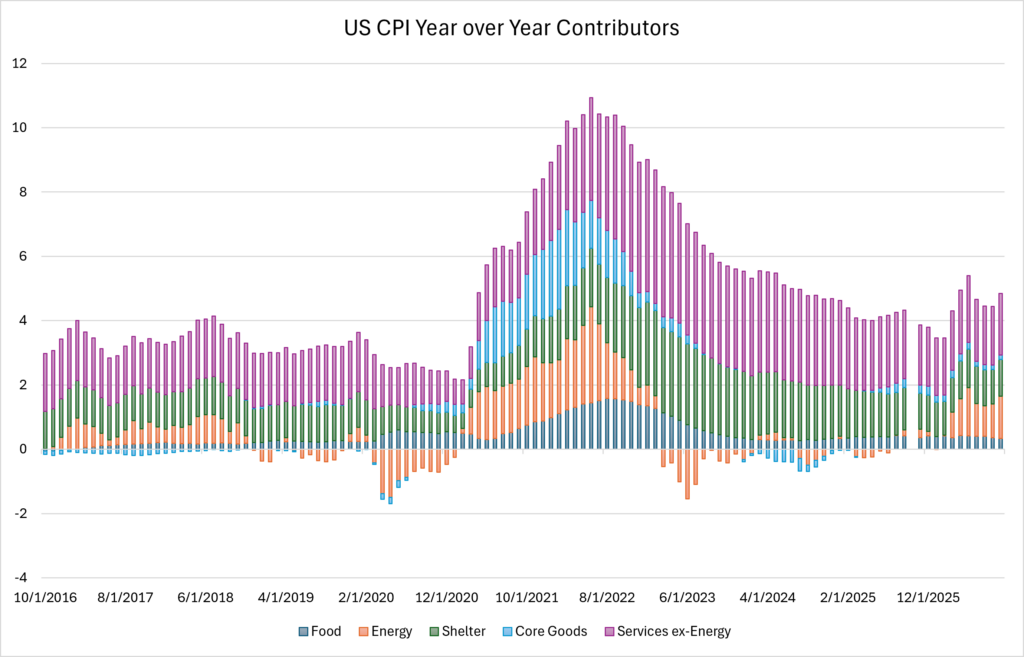
Back in 2022, year over year consumer inflation peaked at just over 9%, which was driven by widespread inflationary pressure across a variety of areas of the economy. So far in 2026, year over year consumer inflation reached a high of 4.2% back in May and now sits at 3.7%. Yes, this is still above the Fed’s target, but this is a very different picture compared to 2022, especially when you dig a little deeper into the underlying contributors to inflation.
Contributions to U.S. CPI Year over Year Growth (October 2016–Present)
Source: LPL Research, Bloomberg 10/20/26
Disclosures: Past performance is no guarantee of future results.
As highlighted in the “Contributions to U.S. CPI Year over Year Growth” chart, the post-COVID-19 economic rebound drove high levels of inflation across most major sectors of the economy. That’s simply not the case today, especially when you examine key components, like shelter and core goods costs, which have remained relatively muted this year. While things could certainly change from here, simply put, we’re not feeling the same level of widespread price pressure that we were back then.
While energy prices have certainly been contributing to higher headline inflation this year, the lack of widespread pressure is encouraging and highlights the difference in the inflation picture now compared to 2022. Until and unless we experience a further broadening out of inflation pressures to encompass more sectors of the economy, the overall risk for markets posed by inflation remains relatively contained.
A Focused Federal Reserve
Speaking of inflation, another key difference now is that we currently have a Fed that is laser focused on reducing inflation. Ever since new Chair Kevin Warsh took charge of the central bank in May, he has cultivated a reputation as an inflation hawk through a combination of words and actions.
This hawkish-bent culminated in the board’s unanimous 12–0 vote at the recent September Federal Open Market Committee meeting to hike the range for the federal funds rate by 25 basis points, up to 3.75–4.00%. This was the first rate hike since July 2023 and represents a relatively swift change of course for a Fed that was cutting rates as recently as December 2025.
Compare this response to the post-COVID-19 economy, when central bankers were slow to react to rising inflationary pressure in 2021 and the start of 2022. Rather than citing transitory factors and advocating for supportive policy, so far this year, central banks have taken decisive action to nip inflationary pressures in the bud.
Despite the pullback in official forward guidance from the Fed under Chair Warsh, markets seem to believe that the central bank will continue to act prudently to contain inflationary pressure. With a series of rate hikes currently priced in throughout the course of 2026 and 2027, investors appear confident in the belief that the Fed is set to firm up policy in order to tamp down inflation as needed.
The Bottom Line
Headlines about rising interest rates and falling bond prices have been front of mind for investors over the past few months, and their concerns are understandable. Taking a step back, however, comparing today’s markets and economy to 2022 shows that there are a number of key differences now that should provide investors with some comfort.
Higher starting interest rates, different inflation drivers, and a responsive Fed are all worth bearing in mind when comparing today’s bond market to 2022. While recent volatility has been a challenge for fixed income investors, the path forward looks promising for patient long term bond holders. With starting rates at or near multi-decade highs across a variety of core fixed income sectors, opportunities within the bond market are well worth considering as a portion of a well-diversified portfolio.
Important Disclosures
This material is for general information only and is not intended to provide specific advice or recommendations for any individual. There is no assurance that the views or strategies discussed are suitable for all investors. To determine which investment(s) may be appropriate for you, please consult your financial professional prior to investing.
Investing involves risks including possible loss of principal. No investment strategy or risk management technique can guarantee return or eliminate risk.
Indexes are unmanaged and cannot be invested into directly. Index performance is not indicative of the performance of any investment and does not reflect fees, expenses, or sales charges. All performance referenced is historical and is no guarantee of future results.
This material was prepared by LPL Financial, LLC. All information is believed to be from reliable sources; however LPL Financial makes no representation as to its completeness or accuracy.
Unless otherwise stated LPL Financial and the third party persons and firms mentioned are not affiliates of each other and make no representation with respect to each other. Any company names noted herein are for educational purposes only and not an indication of trading intent or a solicitation of their products or services.
Asset Class Disclosures –
International investing involves special risks such as currency fluctuation and political instability and may not be suitable for all investors. These risks are often heightened for investments in emerging markets.
Bonds are subject to market and interest rate risk if sold prior to maturity.
Municipal bonds are subject and market and interest rate risk and potentially capital gains tax if sold prior to maturity. Interest income may be subject to the alternative minimum tax. Municipal bonds are federally tax-free but other state and local taxes may apply.
Preferred stock dividends are paid at the discretion of the issuing company. Preferred stocks are subject to interest rate and credit risk. They may be subject to a call features.
Alternative investments may not be suitable for all investors and involve special risks such as leveraging the investment, potential adverse market forces, regulatory changes and potentially illiquidity. The strategies employed in the management of alternative investments may accelerate the velocity of potential losses.
Mortgage backed securities are subject to credit, default, prepayment, extension, market and interest rate risk.
High yield/junk bonds (grade BB or below) are below investment grade securities, and are subject to higher interest rate, credit, and liquidity risks than those graded BBB and above. They generally should be part of a diversified portfolio for sophisticated investors.
Precious metal investing involves greater fluctuation and potential for losses.
The fast price swings of commodities will result in significant volatility in an investor’s holdings.
This research material has been prepared by LPL Financial LLC.
Not Insured by FDIC/NCUA or Any Other Government Agency | Not Bank/Credit Union Deposits or Obligations | Not Bank/Credit Union Guaranteed | May Lose Value
For Public Use – Tracking: #1195901