Oil Rebounds as Global Supply Risks Intensify
Adam Turnquist | Chief Technical Strategist
Last Updated: July 23, 2026
Oil has staged an impressive rebound this month as the conflict between the U.S. and Iran has re-escalated. The memorandum of understanding signed on June 17 created a 60-day window for negotiations, but the diplomatic opening lasted only a few weeks. Both sides subsequently accused the other of violating the peace agreement, and military operations have resumed. The U.S. has now conducted 11 consecutive nights of airstrikes against targets in Iran, while Iranian forces have retaliated across the region. Neither side has provided much clarity on when, or under what conditions, negotiations could restart.
Oil prices have responded by advancing for three consecutive weeks. Brent crude, the global oil benchmark, rose from around $71 a barrel on July 1 to as high as around $95 on July 22, representing a gain of over 30%. The rebound has repaired much of the technical damage created by the deescalation-driven decline that pulled prices lower into early July.
Brent initially found support near $70 and subsequently reversed its short-term downtrend. Prices have moved back above the 50-day and 200-day moving averages and cleared resistance near the 2024 highs around $92. The next important resistance hurdle to clear sets up in the $98–$99 range, marked by the prior 2024 highs and a key retracement level from the April-to-July decline.
Momentum has also improved. The Relative Strength Index (RSI), a momentum oscillator that measures the speed of price movements to assess trend strength, has reversed a downtrend and returned to bullish territory. Positioning could provide another boost to momentum. Speculator or managed money short positions reached year-to-date highs in late June, leaving a lot of investors on the wrong side of the recent price moves. Speculator long positions have also increased notably this month. Positioning dynamics can amplify a rally because short-sellers must buy futures to close losing trades. Once prices break resistance, systematic trend followers may also shift from selling to buying, creating a feedback loop between technical momentum and short covering. While current positioning does not guarantee that oil will continue rising, it does mean that the market entered the latest escalation poorly positioned for an upside surprise. And when sentiment and positioning are extremely bearish, even a modest deterioration in supply expectations can produce an outsized price response.
Technical Progress Continues for Brent
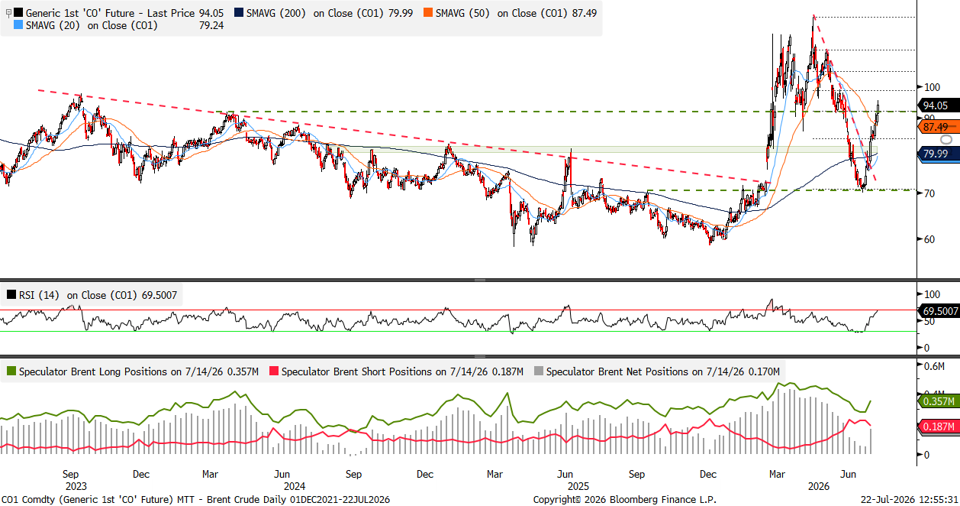
Source: LPL Research, Bloomberg 07/22/26
Disclosures: Any commodities, options, or futures referenced are being presented as a proxy, not as a recommendation. Past performance is no guarantee of future results.
The Red Sea Joins the Supply-Risk Story
The Strait of Hormuz, the most important global chokepoint for oil as it accounts for at least 10% of global oil supply, remains effectively closed. Oil tanker traffic through the critical waterway has moved back to a standstill after a brief uptick in crossings last month. Until recently, Saudi Arabia’s East-West pipeline provided an important bypass to oil stuck in the Persian Gulf as it allowed oil to move across Saudi Arabia to ports on the Red Sea. Since the start of the Iran war, the pipeline had been running near full capacity, moving up to seven million barrels of oil per day. However, this workaround to the Strait of Hormuz closure is now being threatened as the Iran-backed Houthis have recently declared a maritime embargo on Saudi shipping through the Bab el-Mandeb Strait, located at the south end of the Red Sea. As a result, oil tankers have already turned around, halted transit, or turned north toward the Suez Canal. This latest development implies the market is no longer dealing with the supply strain of a signal chokepoint to oil and that the war could be expanding into new territories.
The Supply Cushion Remains Thin
The increase in supply risk comes at a time when strategic petroleum reserves (SPR) remain critically low. In March, the International Energy Agency’s 32 member countries approved a record release of 400 million barrels from emergency reserves to offset disruptions caused by the Middle East conflict. The U.S. accounted for approximately 172 million barrels of that coordinated response. This has left total oil inventories in the U.S. SPR at around 311 million barrels, marking the lowest level of stockpiles since March 1983, according to the U.S. Energy Information Administration. Low inventories do not mean the U.S. is about to run out of oil, but it does mean policymakers have less flexibility to offset another severe or prolonged disruption. Strategic reserves can buy time, but they cannot permanently replace the flow of oil through a major shipping route.
Importantly, the U.S. government’s SPR release was done on an exchange basis rather than an outright sale. Under an exchange release, an entity like a refiner that needs oil now can borrow from the SPR for a short period of time but assumes a contractual obligation to return barrels later, along with a premium for an additional quantity of oil. For example, the most recent exchange offering from the SPR included a minimum 8–9% premium that increases if oil is not returned by a set date (additional return-period premium starts to increase in the April–June period in 2027). This means that replenishment of the SPR could create incremental physical demand as exchange borrowers purchase crude to satisfy their obligations. This could alleviate downside risk even if geopolitical tensions ease as inventories must still be rebuilt.
China could be a wildcard that could help reshape the supply and demand backdrop. Here is an excerpt from our latest Weekly Market Commentary, “China Holds Keys to Post-War Oil Prices“, from Jeffrey Roach, chief economist at LPL:
“The sharp decline in China’s crude oil imports is potentially more bearish than bullish for the global oil market, at least in the near term. China is the world’s largest crude importer, so the big drop in recent months signals that one of the most important sources of global oil demand is not providing the support many producers were hoping for. If the weakness reflects soft industrial activity, slower transportation demand, and cautious refinery runs rather than temporary logistical disruptions, it reinforces concerns that global demand growth could undershoot expectations in the second half of the year. The decline was not solely a demand story. Geopolitical risks in the Persian Gulf and uncertainty surrounding flows through the Strait of Hormuz likely delayed or discouraged some purchases. If trade routes stabilize and Beijing decides to replenish commercial and strategic inventories, imports could rebound sharply in the coming months. In other words, part of the June weakness may represent deferred demand rather than permanently lost demand.”
U.S. Oil Inventories Reach Lowest Level Since 1983
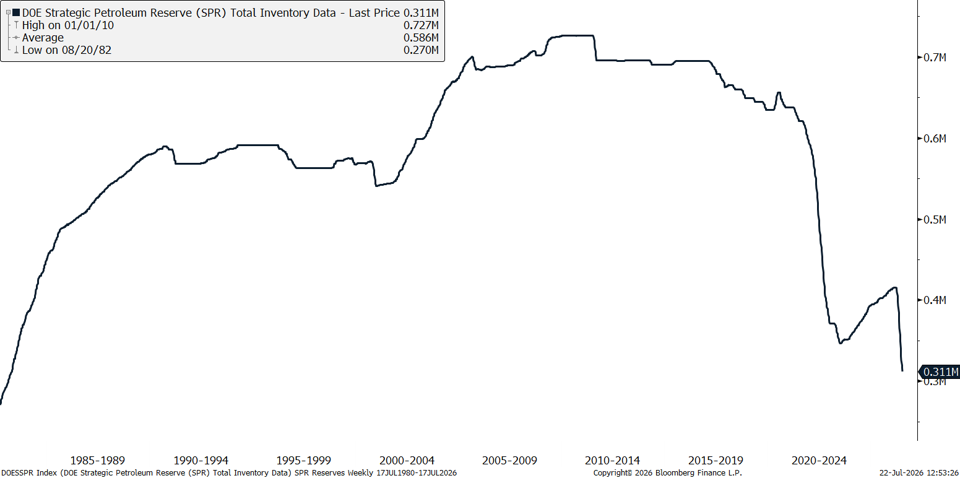
Source: LPL Research, Bloomberg 07/22/26
Conclusion
Oil’s rebound reflects more than renewed geopolitical anxiety. Improving technical momentum, crowded bearish positioning, pressure on two critical shipping routes, and historically low strategic inventories have all made the market more sensitive to supply disruptions. Although weaker demand from China and a return to negotiations could cool the rally, the limited supply cushion suggests oil prices may remain volatile and supported until shipping conditions normalize and inventories begin to recover.
Important Disclosures
This material is for general information only and is not intended to provide specific advice or recommendations for any individual. There is no assurance that the views or strategies discussed are suitable for all investors. To determine which investment(s) may be appropriate for you, please consult your financial professional prior to investing.
Investing involves risks including possible loss of principal. No investment strategy or risk management technique can guarantee return or eliminate risk.
Indexes are unmanaged and cannot be invested into directly. Index performance is not indicative of the performance of any investment and does not reflect fees, expenses, or sales charges. All performance referenced is historical and is no guarantee of future results.
This material was prepared by LPL Financial, LLC. All information is believed to be from reliable sources; however LPL Financial makes no representation as to its completeness or accuracy.
Unless otherwise stated LPL Financial and the third party persons and firms mentioned are not affiliates of each other and make no representation with respect to each other. Any company names noted herein are for educational purposes only and not an indication of trading intent or a solicitation of their products or services.
Asset Class Disclosures –
International investing involves special risks such as currency fluctuation and political instability and may not be suitable for all investors. These risks are often heightened for investments in emerging markets.
Bonds are subject to market and interest rate risk if sold prior to maturity.
Municipal bonds are subject and market and interest rate risk and potentially capital gains tax if sold prior to maturity. Interest income may be subject to the alternative minimum tax. Municipal bonds are federally tax-free but other state and local taxes may apply.
Preferred stock dividends are paid at the discretion of the issuing company. Preferred stocks are subject to interest rate and credit risk. They may be subject to a call features.
Alternative investments may not be suitable for all investors and involve special risks such as leveraging the investment, potential adverse market forces, regulatory changes and potentially illiquidity. The strategies employed in the management of alternative investments may accelerate the velocity of potential losses.
Mortgage backed securities are subject to credit, default, prepayment, extension, market and interest rate risk.
High yield/junk bonds (grade BB or below) are below investment grade securities, and are subject to higher interest rate, credit, and liquidity risks than those graded BBB and above. They generally should be part of a diversified portfolio for sophisticated investors.
Precious metal investing involves greater fluctuation and potential for losses.
The fast price swings of commodities will result in significant volatility in an investor’s holdings.
This research material has been prepared by LPL Financial LLC.
Not Insured by FDIC/NCUA or Any Other Government Agency | Not Bank/Credit Union Deposits or Obligations | Not Bank/Credit Union Guaranteed | May Lose Value
For Public Use – Tracking: #1145237