An Upcoming Eventful Fourth Quarter as Markets Face Key Tests
September 30, 2026 | LPL Research
Today’s blog is written by Chris Fasciano, chief market strategist at Commonwealth. He represents Commonwealth in various media appearances, advisor speaking events, and Commonwealth conferences. He also oversees and mentors a dynamic team of investment research analysts who specialize in equity and fixed income markets. Prior to this role, Chris spent 10 years as one of the firm’s portfolio managers, involved with asset allocation and fund selection. With a deep background in small- and mid-cap stock research, Chris is uniquely positioned to analyze the latest economic data and offer valuable insights on navigating today’s volatile markets. Chris Fasciano is a guest writer and is not affiliated with LPL Financial.
With the days growing shorter and the third quarter coming to a close, investors are turning their attention to the opportunities and risks that could shape markets through December. But volatility isn’t likely to dissipate as the year ends. Many of the concerns that have weighed on investors’ minds will continue to do so. But fundamentals also remain strong, and they have helped markets climb the wall of worry throughout the last two years
As we head into the fourth quarter, some of the major issues that will garner attention are the mid-term elections, interest rates and the Federal Reserve (Fed), and third quarter earnings reports.
Vote in the Booth, Not in Your Portfolio
Headlines about the upcoming election are currently prevalent. History indicates that markets will worry about the outcome and what it means for the path of future policy. This year is no different. Investors are sensitive to whether there will be a Blue Wave or if Republicans can head off any potential losses.
We are currently in the most impactful time of an election cycle for stocks. Markets underperform during mid-term years compared to other years. Most notably, it occurs during the summer through the early fall. That is the peak level of election and policy uncertainty.
But history has insights into what ultimately matters. As the election results become clearer, investor caution dissipates, stocks rally, and the following year is usually a good year for stock investors, though past performance does not guarantee future results. Also, any changes in the power sharing arrangement in Washington as the election results become clearer will have very little impact on returns over the long-term.
S&P Cumulative Index Average Annual Total Return by Power Sharing Arrangement
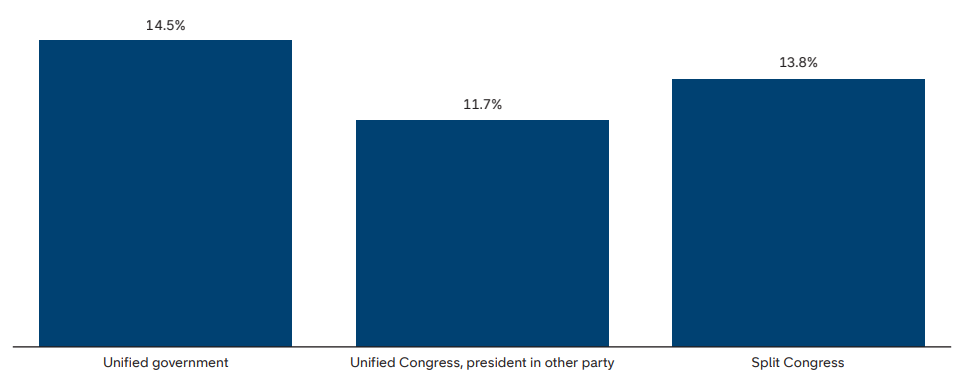
Source: LPL Research, Capital Group, Office of the Clerk — U.S. House of Representatives, Senate.gov, S&P Global. Unified government indicates White House, House and Senate are controlled by the same political party. Unified Congress indicates House and Senate are controlled by the same party, but the White House is controlled by a different party. Split Congress indicates House and Senate are controlled by different parties, regardless of the White House control. Data excludes 2001 due to Senator Jim Jeffords switching party mid-year. As of December 31, 2025.
Disclosures: Indexes are unmanaged and cannot be invested in directly. Past performance is no guarantee of future results. Estimates may not develop as predicted and are subject to change.
The “S&P Cumulative Index Average Annual Total Return by Power Sharing Arrangement” chart highlights that over the long-term, returns don’t indicate a large difference because of which party controls the White House, the Senate, or the House.
Fundamentals are far more important.
Bond Yields Are Surging: How Far Will the Fed Go?
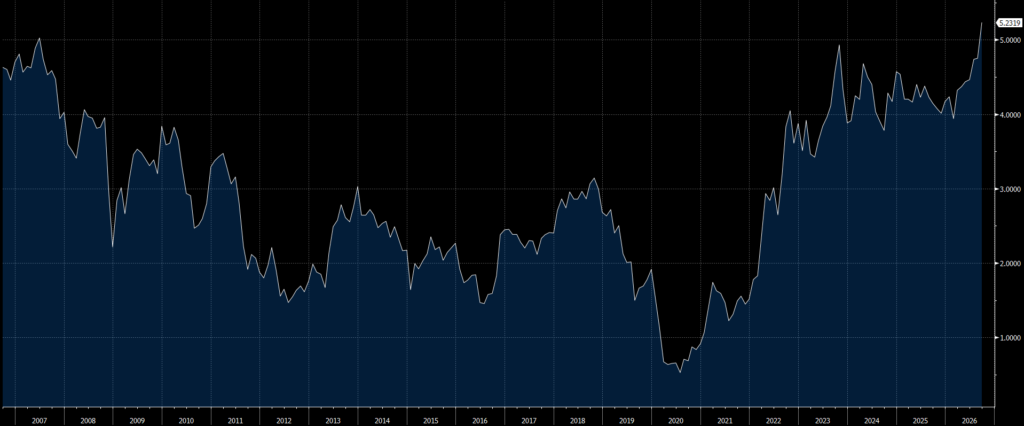
The 10-year Treasury yield has surged to over 5.2%. This compares to roughly 4.75% at the end of August. That movement and level have caught the attention of bond and equity investors as well as the Fed.
20 Year High in the 10-Year Treasury Yield
Source: LPL Research, Bloomberg 09/28/26
The “20 Year High in the 10-Year Treasury Yield” chart illustrates that this is the first time the bellwether bond has reached that level since July of 2007. Because yields have not reached these levels in more than 19 years, the move has understandably captured investors’ attention. While much of the recent rise in yields appears to have been driven by the escalating conflict in the Middle East, the resultant higher oil prices, and rising near-term inflation expectations, the move over the past week seemed to correlate with the stronger economic data seen in the September manufacturing, services, and composite Purchasing Managers’ Indexes (PMIs).
While in a vacuum, strong economic growth and accelerating inflation have different implications for investors’ portfolios, in the current environment, both would most likely result in the Fed increasing interest rates in an attempt to mitigate the impact. In addition, Chair Warsh has commented that the Fed should take guidance from the bond market when considering interest rate policy. And the bond market seems to be sending a strong message that the Fed is behind the curve when it comes to tightening.
Markets currently expect four additional rate increases over the next twelve months. Expectations from market participants are also leaning toward another 25-basis point (0.25%) hike at the October 28th meeting despite proximity to the midterm elections. How much pressure higher bond yields put on the Fed to do so will be a significant factor in determining the future path of bond market performance.
While higher yields could pressure equity valuations, corporate earnings remain the most important support for stocks.
Will Corporate America Continue to Carry the Day?
Despite all the headwinds that companies have faced over the last couple of years, their ability to deliver strong earnings has not slowed. Analysts currently expect third-quarter earnings to grow by more than 29%. If this were to hold, it would mark the third straight quarter of earnings growth over 25%.
Over the last seven quarters, companies have been able to deliver earnings above expectations, and it is certainly encouraging that all eleven sectors are expected to show year-over-year growth. But as those expectations increase, the bar gets raised, and the possibility of disappointment does increase.
Investors will be focused on any signs that earnings growth is peaking and that we have reached an inflection point for stocks.
Strong but Slower Growth Ahead?
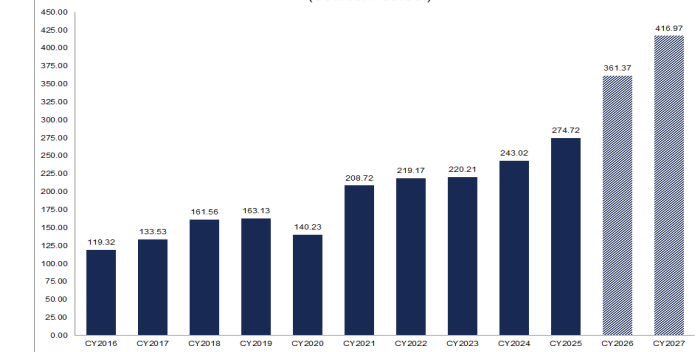
S&P 500 earnings per share historical and estimates
Source: LPL Research, FactSet 09/25/26. The economic forecasts set forth in this material may not develop as predicted and there can be no guarantee that strategies promoted will be successful. Past performance does not guarantee future results. Indexes are unmanaged and may not be invested in directly.
The “Strong but Slower Growth Ahead?” chart shows that if estimates prove accurate, 2026 will end with 31.5% earnings growth. As I have mentioned before, that is stunning performance in any environment, let alone the current one. While it is too early to hang our hats on 2027 estimates, analysts are currently expecting just over 15% growth. Double-digit earnings growth is usually considered a solid performance for corporate America, but it would be roughly half as much as this year’s growth. It would be more in line with 10% and 13% growth seen in 2024 and 2025, respectively. Those were two very strong years for S&P 500 returns, albeit driven almost exclusively by the largest companies in the index.
What would be most encouraging is if this year and next year come with more earnings breadth than the previous two years. Those years were driven almost exclusively by strong earnings growth from the Magnificent Seven companies.
Market Headwinds Lead to Opportunities
I will often come back to some of the lessons I learned early in my career that have served as the underpinnings of my investment philosophy. Despite the many changes I’ve seen in the investment business since then, those lessons still resonate after all these years.
The first is that there are always opportunities to add value to portfolios; you just need to find them. The second is that over the long term, fundamentals drive markets. While it is never easy to tune out the headlines and ignore short-term market moves, remembering those two life lessons has helped me navigate the most difficult and emotional market environments of my career.
The current backdrop is not yet one of those periods. But there is certainly a fair amount to worry about. There always is. Risks are not likely to disappear anytime soon, but neither are the underlying strengths supporting the economy and corporate America. As earnings season unfolds, investors should focus less on headlines and more on whether fundamental trends continue to support profits, growth, and long-term market performance.
Whatever lies ahead, a diversified portfolio remains one of the most effective tools for navigating unexpected twists and turns in the market.
Important Disclosures
This material is for general information only and is not intended to provide specific advice or recommendations for any individual. There is no assurance that the views or strategies discussed are suitable for all investors. To determine which investment(s) may be appropriate for you, please consult your financial professional prior to investing.
Investing involves risks including possible loss of principal. No investment strategy or risk management technique can guarantee return or eliminate risk.
Indexes are unmanaged and cannot be invested into directly. Index performance is not indicative of the performance of any investment and does not reflect fees, expenses, or sales charges. All performance referenced is historical and is no guarantee of future results.
This material was prepared by LPL Financial, LLC. All information is believed to be from reliable sources; however LPL Financial makes no representation as to its completeness or accuracy.
Unless otherwise stated LPL Financial and the third party persons and firms mentioned are not affiliates of each other and make no representation with respect to each other. Any company names noted herein are for educational purposes only and not an indication of trading intent or a solicitation of their products or services.
Asset Class Disclosures –
International investing involves special risks such as currency fluctuation and political instability and may not be suitable for all investors. These risks are often heightened for investments in emerging markets.
Bonds are subject to market and interest rate risk if sold prior to maturity.
Municipal bonds are subject and market and interest rate risk and potentially capital gains tax if sold prior to maturity. Interest income may be subject to the alternative minimum tax. Municipal bonds are federally tax-free but other state and local taxes may apply.
Preferred stock dividends are paid at the discretion of the issuing company. Preferred stocks are subject to interest rate and credit risk. They may be subject to a call features.
Alternative investments may not be suitable for all investors and involve special risks such as leveraging the investment, potential adverse market forces, regulatory changes and potentially illiquidity. The strategies employed in the management of alternative investments may accelerate the velocity of potential losses.
Mortgage backed securities are subject to credit, default, prepayment, extension, market and interest rate risk.
High yield/junk bonds (grade BB or below) are below investment grade securities, and are subject to higher interest rate, credit, and liquidity risks than those graded BBB and above. They generally should be part of a diversified portfolio for sophisticated investors.
Precious metal investing involves greater fluctuation and potential for losses.
The fast price swings of commodities will result in significant volatility in an investor’s holdings.
This research material has been prepared by LPL Financial LLC.
Not Insured by FDIC/NCUA or Any Other Government Agency | Not Bank/Credit Union Deposits or Obligations | Not Bank/Credit Union Guaranteed | May Lose Value
For Public Use – Tracking: #1183955